Computer Fundamentals • Section 1

Secure Image Steganography

AES-128 • Sobel Edge Detection • 1-Bit LSB

A live and beginner-friendly explanation of the research paper “An Edge Detection with LSB and AES Encryption Based Image Steganography.” This website explains the paper and lets you test the process by generating a new cover image, hiding a message and recovering it again in the browser.

Presenter: Taufiq Mahmud
ID: 2022200000116
Course: CSE141.1: Computer Fundamentals
Professor: Md Maruf Hasan
Generated Cover PNG
Secret text→ AES→ Binary bits
Ciphertext
Sobel edgesLSB + XORPixel update
Stego Image

A stego image looks normal but secretly contains encrypted data.

Beginner-friendly explanation

What is this research about?

The paper combines cryptography and steganography. Cryptography locks the message and steganography hides the locked message inside an image. Together they provide stronger protection because the message is both encrypted and hidden.

🔐

Cryptography

Converts readable plaintext into unreadable ciphertext using an encryption key.

🖼️

Steganography

Hides the existence of secret data inside another file such as an image.

📦

Stego Image

The final image that looks normal but secretly carries encrypted hidden data.

0️⃣1️⃣

Binary Data

Computers store text as bits. The secret message must become 0s and 1s before embedding.

Problem statement

Why are we doing this?

Traditional image steganography can be weak when it hides data in predictable locations or smooth areas of an image. Smooth areas can show distortion more easily. If attackers detect the hidden data and the message is not strongly encrypted, the secret may be exposed.

This research aims to create a more secure and less noticeable method by first encrypting the message using AES-128 and then hiding the encrypted bits in selected edge pixels using 1-bit LSB and XOR embedding.

Research Goal

Security + invisibility + image quality

  • Protect the message with AES encryption.
  • Hide the encrypted data inside a PNG image.
  • Use Sobel edge detection to select better pixels.
  • Use 1-bit LSB to reduce visible distortion.
  • Evaluate quality with PSNR, MSE and RMSE.

Scope of the research

What does the paper focus on?

PNG cover images
AES-128 encryption
Sobel edge pixel selection
1-bit LSB embedding
XOR-based embedding and retrieval
PSNR, MSE and RMSE evaluation

Live methodology flow

How the method works

The research has two major parts: embedding and retrieval. Embedding hides the secret message. Retrieval brings it back.

1

Secret Message

User writes a message.

2

AES-128

Message becomes ciphertext.

3

Binary

Ciphertext becomes bits.

4

Sobel Filter

Edge pixels are selected.

5

LSB + XOR

Bits are hidden in pixels.

6

Stego Image

Final secret image is created.

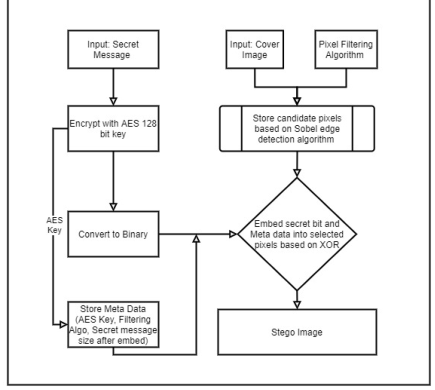
Embedding Process

Embedding process diagram from the paper

The message is encrypted using AES, converted into binary and embedded into selected pixels from the cover image. The result is the stego image.
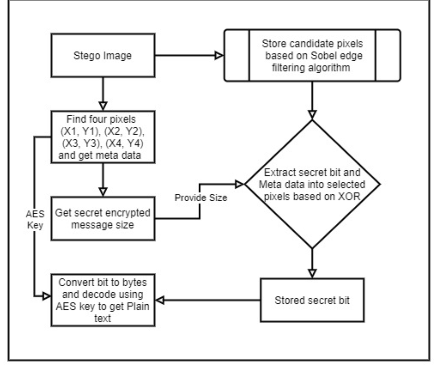
Retrieving Process

Retrieving process diagram from the paper

The receiver uses the stego image, pixel filtering logic, message size and AES key to extract and decrypt the hidden message.

Interactive live testing

Generate and Recover a Stego Image

No upload is needed for the cover image. Every click generates a different PNG cover image in the browser. Then the website encrypts your message, converts it into bits, selects edge pixels and produces a downloadable stego image.

Note: This is a browser-based educational implementation. It uses AES-GCM with a 128-bit key, converts encrypted data to binary, selects Sobel edge pixels and embeds bits using an LSB + XOR style process. The research paper was implemented in C# and describes its own metadata process. Source code repository: GitHub Repository.

Part A: Create Stego Image

Click “Generate New Cover PNG” to start.

AES key, save this:
Live process:

    Part B: Recover Message

    Upload the downloaded stego PNG here. The website will check whether the image contains valid hidden demo metadata. Then paste the same AES key to recover the original text.

    Upload the downloaded stego image first.

    Recovered message:
    Extraction process:

      Generated Cover Image Preview

      Stego Image Preview

      Live LSB explanation

      How LSB changes inside your generated image

      This panel does not use a fixed 150 → 151 example. It uses real pixel values from the generated stego image. It shows the selected pixel, the original blue channel, the secret bit, the XOR calculation and the final changed bit.

      Selected pixel
      Original Blue value
      Secret bit to hide
      XOR rule used
      Final Blue value
      Visual meaning Generate a stego image to see live LSB.

      Video presentation

      Watch the explanation

      Result and conclusion

      What was achieved?

      The paper tested the method using 512×512 PNG images such as Lenna, Baboon and Parrot. The proposed model achieved high PSNR and low MSE/RMSE, meaning the stego image stayed very close to the original image.

      PSNR

      Higher PSNR means better image quality. The proposed model achieved strong PSNR values.

      MSE

      Lower MSE means less difference between the original image and the stego image.

      RMSE

      Lower RMSE means lower distortion and better similarity with the cover image.
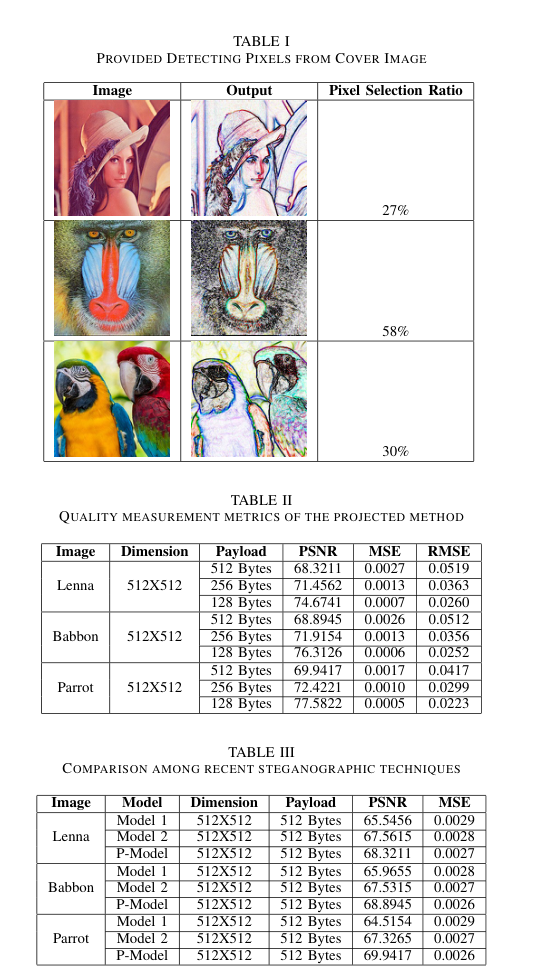
      Edge Detection and Result Tables

      Quality measurement and comparison tables

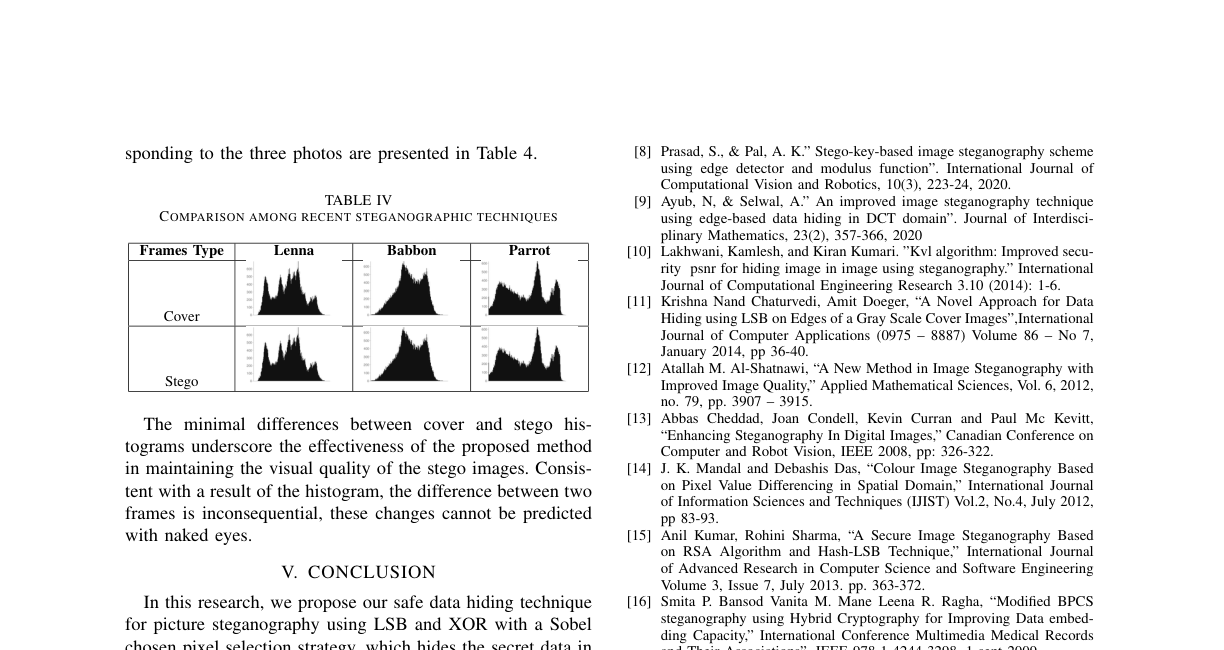
      Histogram Comparison

      Cover and stego histogram comparison

      Cover, Edge and Stego Visuals

      Steganography visuals

      Conclusion

      The method improves secure hidden communication by combining AES encryption, Sobel edge pixel selection, 1-bit LSB and XOR-based embedding.

      Applications

      Secure communication, digital watermarking, copyright protection, confidential document exchange, medical data protection and ownership marking.

      Future Work

      Use machine learning for stronger pixel selection, improve resistance to steganalysis attacks, test more image formats and improve dynamic key generation.

      Summarized literature review

      How previous works connect

      The paper reviews earlier methods including fuzzy edge detection, Kirsch operator, OPAP, Hamming code, Canny edge detection, DCT-domain hiding, RSA, DES and other LSB-based methods. The proposed method improves the idea by combining AES encryption with Sobel edge filtering and 1-bit LSB/XOR embedding.

      Fuzzy Edge DetectionKirsch OperatorOPAPHamming CodeCanny EdgeDCT DomainRSADESHash-LSB

      Complete citations

      References from the Research Paper

      All listed references from the uploaded research paper are included below.

      1. Challita, Khalil, and Hikmat Farhat. ”Combining steganography and cryptography: new directions.” International Journal on New Computer Architectures and Their Applications (IJNCAA) 1.1 (2011): 199-208.
      2. Kumari, Pritam, Chetna Kumar, and Jaya Bhushan Preeyanshi. ”Data security using image steganography and weighing its techniques.” International Journal Of Scientific Technology Research 2.11 (2013): 238-241.
      3. Gupta Banik, Barnali, Manish Kumar Poddar, and Samir Kumar Bandyopadhyay. ”Image steganography using edge detection by Kirsch operator and flexible replacement technique.” Emerging Technologies in Data Mining and Information Security: Proceedings of IEMIS 2018, Volume 3. Springer Singapore, 2019.
      4. Banik, B. G., Poddar, M. K., & Bandyopadhyay, S. K. ”Image Steganography Using Edge Detection by Kirsch Operator and Flexible Replacement Technique”. In Emerging Technologies in Data Mining and Information Security (pp. 175-187). Springer, Singapore, 2019.
      5. Bhardwaj, M., Singh, L., & Saini, K. K. ”An Efficient Approach to Information Hiding through Image Steganography using Edge Detection”. In 2019 4th International Conference on Information Systems and Computer Networks (ISCON) (pp. 564-571). IEEE, November 2019.
      6. Wang, Y., Tang, M., & Wang, Z.” High-capacity adaptive steganography based on LSB and Hamming code”. Optik, 164685, 2020.
      7. Delmi, A., Suryadi, S., & Satria, Y. ”Digital image steganography by using edge adaptive based chaos cryptography”. In Journal of Physics: Conference Series (Vol. 1442, No. 1, p. 012041). IOP Publishing, January 2020.
      8. Prasad, S., & Pal, A. K.” Stego-key-based image steganography scheme using edge detector and modulus function”. International Journal of Computational Vision and Robotics, 10(3), 223-24, 2020.
      9. Ayub, N, & Selwal, A.” An improved image steganography technique using edge-based data hiding in DCT domain”. Journal of Interdisciplinary Mathematics, 23(2), 357-366, 2020
      10. Lakhwani, Kamlesh, and Kiran Kumari. ”Kvl algorithm: Improved security psnr for hiding image in image using steganography.” International Journal of Computational Engineering Research 3.10 (2014): 1-6.
      11. Krishna Nand Chaturvedi, Amit Doeger, “A Novel Approach for Data Hiding using LSB on Edges of a Gray Scale Cover Images”,International Journal of Computer Applications (0975 – 8887) Volume 86 – No 7, January 2014, pp 36-40.
      12. Atallah M. Al-Shatnawi, “A New Method in Image Steganography with Improved Image Quality,” Applied Mathematical Sciences, Vol. 6, 2012, no. 79, pp. 3907 – 3915.
      13. Abbas Cheddad, Joan Condell, Kevin Curran and Paul Mc Kevitt, “Enhancing Steganography In Digital Images,” Canadian Conference on Computer and Robot Vision, IEEE 2008, pp: 326-322.
      14. J. K. Mandal and Debashis Das, “Colour Image Steganography Based on Pixel Value Differencing in Spatial Domain,” International Journal of Information Sciences and Techniques (IJIST) Vol.2, No.4, July 2012, pp 83-93.
      15. Anil Kumar, Rohini Sharma, “A Secure Image Steganography Based on RSA Algorithm and Hash-LSB Technique,” International Journal of Advanced Research in Computer Science and Software Engineering Volume 3, Issue 7, July 2013. pp. 363-372.
      16. Smita P. Bansod Vanita M. Mane Leena R. Ragha, “Modified BPCS steganography using Hybrid Cryptography for Improving Data embedding Capacity,” International Conference Multimedia Medical Records and Their Associations”, IEEE 978-1-4244-3298, 1 sept 2009.
      17. Bourbakis, N., et al. ”A synthetic stegano-crypto scheme for securing multimedia medical records and their associations.” 2009 16th international conference on digital signal processing. IEEE, 2009.
      18. Alam, Sheikh Thanbir, Nusrat Jahan, and Md Maruf Hassan. ”A New 8-Directional Pixel Selection Technique of LSB Based Image Steganography.” Cyber Security and Computer Science: Second EAI International Conference, ICONCS 2020, Dhaka, Bangladesh, February 15-16, 2020, Proceedings 2. Springer International Publishing, 2020.
      19. Bhuiyan, Touhid, et al. ”An image steganography algorithm using LSB replacement through XOR substitution.” 2019 International Conference on Information and Communications Technology (ICOIACT). IEEE, 2019.
      20. Ansari, A.S., Mohammadi, M.S. and Parvez, M.T., A comparative study of recent steganography techniques for multiple image formats. International Journal of Computer Network and Information Security, 11(1), pp.11-25, 2019.
      21. K. Patel, “Performance analysis of aes, des and blowfish cryptographic algorithms on small and large data files,” International Journal of Information Technology 11(4), 813–819 (2019).
      22. Alam, S. T., Hassan, M. M., Ahmad, R. B., Yaakob, N., Mou, M. T., Ong, B. L., & Kahar, N. F. ”A Modified Lsb Image Steganography Method Using Msb-Based Pixel Filtering Algorithm.” Journal of Advanced Research in Applied Sciences and Engineering Technology, 32-48, Oct. 2024, doi: https://10.37934/araset.62.1.3248